
A REVIEW OF TRANSCRIPTION: A NOVEL BY BEN LERNER
by Wred Fright
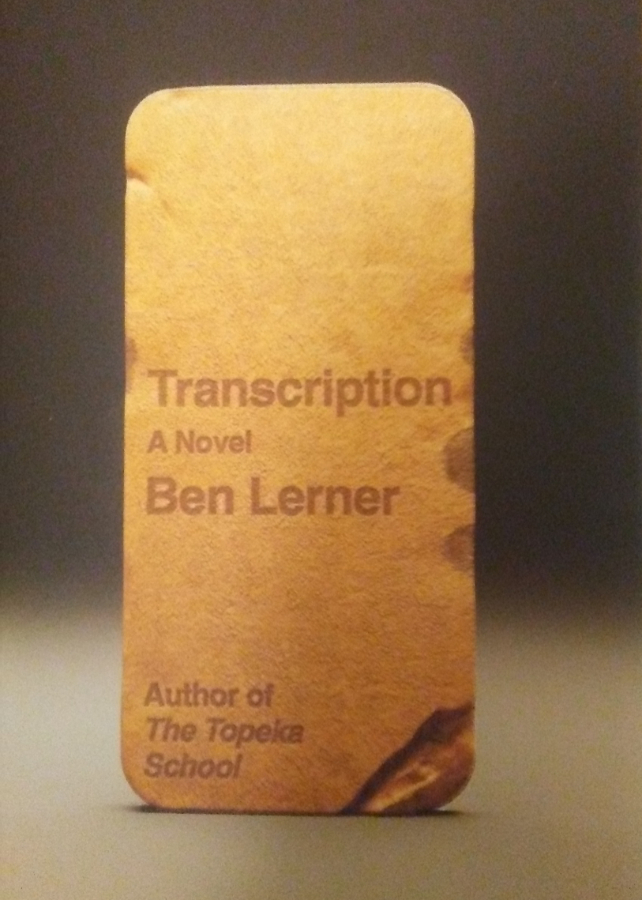
This novel is partly set in Providence, Rhode Island, USA, and it took only a few pages of reading it before I started hoping one of H.P. Lovecraft’s demons was still hanging out there and would eat the neurotic narrator and end the misery (in the unlikely event the book inspires some fan fiction, I highly recommend that approach). The book ain’t all bad though. The cover is nifty and well designed. Go touch it sometime in a bookstore. Feel the texture of the cell phone on the front and back cover. Very nice job designers Rodrigo Corral and Violet Dine and whoever actually printed the dustjackets in China or wherever! I can’t recommend reading this book, but I can recommend fondling it. Score one for print because you can’t fondle an epub. Also, I can’t tell you how many contemporary books have typos in them. I wasn’t looking for any because if you look you will find one even if none is actually there, but Transcription is one of the few recent books that seems to be typo-free, so kudos to Lerner and his copyeditors. Lerner also has an eye for good images. I particularly liked the one with Beethoven biting a stick to hear the music he was composing. While I doubt I will ever read another novel by Lerner, I would read one of his poems.
Unfortunately, that’s about all the nice things I have to say about the book, and I apologize to Lerner if he ever reads this because I don’t like hurting people’s feelings, but if he’s a true artist, then he won’t give a shit what I or anyone else thinks anyway. Besides it’s not Lerner I’m mad at. Anyone can have an off-day at the office and write a bad book. It’s the literary industrial complex that promotes crap like this I’m mad at. More on that later though. Let’s get back to the book and what I didn’t like about it.
One, I found the book boring. I didn’t care about any of the characters; they all seemed flat and emotionless to me (I really hope this is by design and the book isn’t a roman à clef and this is not how some real people actually are). The first line of the novel is “I was falling asleep on the train” and that’s how I felt reading. If I hadn’t already promised Good King Wenclas that I’d review a book for New Pop Lit, I wouldn’t have finished it. I thought about asking for another book but decided to take the hit for the team.
Two, the book is too short. I mean I liked that aspect as a reviewer since I didn’t like the book and didn’t have to plow through as many pages (imagine not liking The Brothers Karamazov and still having to read hundreds more pages to write a review), but on behalf of paying readers I still have to protest. $25 for 132 pages of novel or whatever is ridiculous; that’s 53 cents a page or something (and 7 of those pages in the novel are blank and 3 more just list the name of the hotel that’s the setting of that section, though in one case that setting is metaphorical). I know there’s inflation, but come on, literary industrial complex, let’s provide some value for money. No wonder people subscribe to Netflix for a month instead of buying a new book.
Three, there’s not much of a story here. Like most contemporary American fiction that’s not genre fiction involving detectives, vampires, or Amish maidens, or better yet an Amish maiden who’s a vampire detective, the main characters are rich people. They’re writers and professors, so they’re “poor” rich people but compared with most everyone you know if you ain’t rich that is, they’re fucking rich and flying around America and off to Europe like most folks go to the supermarket. They ain’t worried about the cost of gas, just having the latest smartphone and namedropping the right names of literary theorists and conceptual artists. I guess academics, particularly those in the pyramid schemes known as creative writing programs, are one of the few demographics who still read nongenre fiction, so I get the financials of the approach, but it’s kind of boring when every other novel is about a writer or professor. I mean you can mine some good fiction out of that area like Richard Russo did in Straight Man and Henry Miller and Charles Bukowski did in their autobiographical fiction (the fact that those characters were all poorer writers probably helped), but these MFAers need to either do some research or they need to drop out of their MFA programs and become plumbers or something and write in the evenings; we might get some more interesting fiction then. So basically, the unnamed narrator (if he has a name I missed it–maybe I had fallen asleep at that point) breaks his cell phone and has an existential crisis (no, I’m not spoiling anything because there’s no real story to spoil). He interviews his old professor. He goes to an academic conference in Spain where people get mad he transcribed the interview from memory because his phone was broken. Then he goes to Los Angeles and has a conversation with the now deceased professor’s son in which they mostly talk about how the son’s daughter didn’t like to eat at one point. There are some references to current events such as the virus panic and the war in Gaza, but those are basically window-dressing and not essential to what little plot there is. Mainly Lerner’s point seems to be that people are so obsessed with their Star Trek phones these days they are losing their humanity (which may explain why the narrator never gets a name). He’s certainly right about the phone being a symbol for connection to the lives of others, somewhat explaining how people get obsessed with the devices and feel isolated if they are separated from it. Humans are social. That’s assuming that’s what Lerner was going for here. He seemed to also be going for some philosophizing about the nature of memory and the relationships between parents and children. It’s all sort of hazy because the book seems half-baked to me (I don’t know if the dude had writer’s block, needed money, or it was a deadline issue, but something’s off about this book). Maybe it’s just the corporate American lit novel on its way to getting so short that it will disappear completely. If this is the kind of crap they put out now, we should be so lucky, eh?
Maybe more American novelists ought to say fuck the corporations and tenure track jobs that actually seem to keep them from writing more often than not (you can self-publish easily these days, though the stigma of vanity publishing can still be sniffed) and write for more Americans beyond a small set of some hypereducated snobby fuckheads. What passes for contemporary American literary culture seems to be a circle jerk mutual admiration society. If I gave this novel to the chick with the long nails who sits next to me in cubicleville, she’d probably say “What the fuck is this shit?” and throw it back to me. The chick with the long nails is smart; she just probably thinks there’s nothing worth reading. She’s wrong, but given the crap corporate publishers hype, I can’t blame her too much. I didn’t know anything about Lerner or the book before reading it; Wenclas just sent it to me and said review this. But after I read it, I researched it and found that apparently all the other literary critics had lost their minds and thought it was wonderful. Did these other reviewers raving about it read the same fucking book I did? Or did some rich person tell them the book was great, so they didn’t bother to read it themselves? I don’t know. Anyway, I got it for free, so I can’t complain too much. You can get it for free also since I’m going to chuck it in a little free library in some affluent area of Cleveland, Ohio USA (don’t laugh–they actually exist) where people always think like The New York Times tells them to, but I’d recommend you read a James Nowlan novel or something actually interesting instead of this.
(Farrar, Straus and Giroux, who apparently due to budget cuts or something can’t afford another comma between Straus and Giroux, 2026.)
*******
Dr. Wred Fright has written several novels, including The Front Yard War (perfect reading this time of year), and also creates music. He’s also an historian of underground writing and publishing. For more information click on https://www.wredfright.com


One thought on “Where’s Chthulu When We Need Him?”